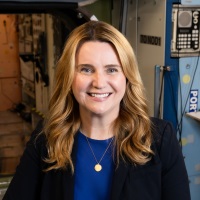
Mari Anne Snow | CEO, Co-Founder
Eascra Biotech

Mari Anne Snow is the CEO and co-founder of Eascra Biotech, where she leads commercialization of the company’s DNA-inspired nanomaterial platform to enable next-generation therapeutic delivery and regenerative medicine. She has successfully secured millions in non-dilutive funding from NASA, NSF, the ISS National Lab, and the U.S. Air Force to advance Eascra’s Earth- and space-based manufacturing strategy. With a background spanning biotechnology, executive leadership, and strategic growth, she has built global partnerships across academia, industry, and government to accelerate clinical translation. Mari Anne is a recognized advocate for the future of in-space biomanufacturing and is committed to bringing transformative therapies to patients with unmet medical needs.
Appearances:
Festival of Biologics Day 1 @ 12:00
Building a Manufacturing Process in Low Earth Orbit — Infrastructure, Supply Chain and Regulatory Pathways
Microgravity is usually discussed as a research environment. Eascra is treating it as a manufacturing parameter. Janus Base Nanoparticles — a DNA-inspired, non-lipid delivery platform designed to reach tissue types lipid nanoparticles cannot reliably access — show measurably better structural consistency and therapeutic performance when formulated in orbit than in matched Earth-made controls. Turning that observation into a supply chain is a different problem from proving it.
Under NASA's InSPA Phase II contract, Eascra is developing semi-autonomous production hardware with two independent engineering partners, running coordinated synthesis campaigns aboard the ISS, and returning material for ground characterisation. This session covers what industrialising that actually requires: the hardware and infrastructure needed for autonomous production off-planet, the reagent stability and cold-chain constraints that shape an orbital supply chain, and the regulatory work of framing microgravity as a controllable process parameter under ICH Q8, Q9 and Q10 rather than an exception to them.
- Why microgravity changes the product rather than just the experiment — comparative data on JBNp structural consistency, cargo loading and delivery efficiency against Earth-made controls
- What orbital manufacturing infrastructure demands in practice — semi-autonomous production hardware, remotely triggered synthesis runs, reagent stability windows, and downmass and cold-chain design
- Building a regulatory pathway that mirrors terrestrial standards — treating microgravity as a controllable GMP process parameter under ICH Q8/Q9/Q10, and what that implies for scale-up and eventual commercial supply
Festival of Biologics Day 2 @ 09:45
Plenary Panel: Beyond the Atmosphere: Unlocking Space and Microgravity for Biologics Manufacturing and Commercialisation, sponsored by BioOrbit

Created by


Terrapinn is proud to be a member of isla.
Working together to build sustainable events